Provincial News
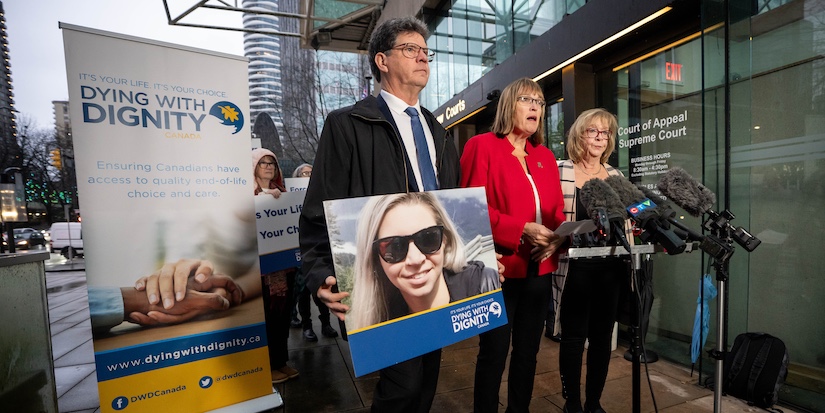
Dying With Dignity Canada CEO Helen Long, centre, speaks before the start of the B.C. Supreme Court trial, flanked by the parents of Samantha O’Neill, Jim, left, and Gaye, right, O’Neill in Vancouver, on Monday, Jan. 12, 2026.
THE CANADIAN PRESS/Ethan Cairns
Charter challenge of religious exemption to assisted dying law heads to court in B.C.

Published 11:55 PST, Mon January 12, 2026
Last Updated: 1:28 PST, Mon January 12, 2026


-
The B.C. Supreme Court has begun hearing a case that questions whether faith-based publicly funded hospitals have the right to refuse certain procedures on the basis of their religious beliefs.
Dying With Dignity Canada is part of a group of plaintiffs bringing a Charter challenge against the B.C. government, Vancouver Coastal Health and Providence Health Care.
"This case highlights the harm caused when patients are forced to leave the care settings they know and trust in order to receive medical assistance in dying," said Dying With Dignity Canada's CEO, Helen Long, at a press conference Monday in Vancouver.
Providence is a Catholic organization that operates 18 health and long-term care facilities in Vancouver.
The B.C. government allows faith-based organizations, including Providence, to opt out of providing medical assistance in dying in their facilities, as long as patients are transferred elsewhere.
The plaintiffs include the parents of 34-year-old Sam O'Neill, who had to be transferred from St. Paul's hospital to receive MAID in April 2023.
Gaye and Jim O'Neill say their daughter was in excruciating pain during the transfer and they allege in court filings that the transfer meant Sam's loved ones didn't get a chance to say goodbye.
"There was no medical justification for the transfer," Gaye O'Neill told reporters at Monday's press conference.
She said the family believes Sam's Charter rights to freedom of religion and life, liberty and security of the person were violated when she was forced to move from the hospital.
In its statement of defence, Providence defended the care provided to Sam O'Neill during the transfer to another facility.
It argued that she "stated her desire for the provision of MAID to be available to her at St. Paul’s Hospital but she remained aware of the requirement for her to transfer to a (Vancouver Coastal Health) facility before receiving MAID." It said she had the choice to continue her treatment at St. Paul's or at another hospital where assisted dying could be provided.
Long said they intend to argue that "no one religion or religious doctrine is allowed to restrict or override access to legal medical care."
"In a publicly funded health care system, patient rights, dignity and autonomy must come first, particularly at end of life when people are most vulnerable," she said.
The final plaintiff, Dr. Jyothi Jayaraman, is a palliative care physician and a MAID provider who previously worked for Providence.
In court documents, she said Providence took over operation of two hospices where she worked in 2023. Dr. Jayaraman said she learned that patients who wanted assistance in dying would be forced to move, and said that as the attending physician she would have to certify that the move was necessary and the patient was able to be moved.
"Authorizing the move was something I could not be involved with as a matter of principle. No patient under my care would be forced to move based solely on the organization’s religious mission," she wrote in an affidavit.
She resigned from her position with Vancouver Coastal Health in February 2023 and now works exclusively as a MAID assessor and provider.
Dr. Jayaraman said that since 2016, she has provided MAID to 44 people who had to be moved from faith-based facilities to access the procedure.
In court documents, she described some of those incidents as "very distressing" because patients were in pain during the move, or were heavily sedated and unable to communicate with family members.
Since 2023, 122 people have been transferred out of faith-based facilities within Vancouver Coastal Health to obtain MAID, including 49 who were taken to an "adjacent space."
Health Canada's latest data from 2024 shows 349 people who died with medical assistance in Canada were first transferred out of a facility due to its policies.
The statement of claim in the case argues that the Section 2 Charter rights of physicians and MAID providers are being infringed on when they are forced to transfer patients "in order to conform with, and implement, the religious beliefs of others."
Rev. Dr. Andrew Bennett, the director of faith community engagement at the think tank Cardus, said the case will centre on the question of choice in health care.
He noted that many hospitals across the country have a faith foundation and most do not want to allow euthanasia.
"There's really a conflict between the role of the state in funding health care and the interests of faith-based hospitals that have been around in this country for more than 100 years," he said.
St. Paul's Hospital in Vancouver, for instance, was founded by an order of nuns in 1894. Over the years its work has included charitable work, and it now provides health care to people of all faiths.
Its Catholic identity is “grounded in the principle that every human life has inherent dignity from conception to natural death," court documents say.
Providence Health argues in its statement of defence that Section 2 of the Charter shields it from being "compelled to provide services that are contrary to deeply and sincerely held beliefs" and that its decision not to provide MAID is not subject to the Charter.
"The state has a fundamental duty under the Charter to not simply respect fundamental freedoms like freedom of religion and freedom of conscience, but to uphold it and to defend it," Bennett said.
This report by The Canadian Press was first published Jan. 12, 2026.






2 Hours of free financial consulting
Jai Xin Planning Ltd.
C$120.00 C$0.00

Use any of our home staging service and get a second month rental for free!
MiiX Interiors
C$500.00 C$0.00

Get 10% off any order
Phantom Screens Lower Mainland
C$200.00 C$180.00